
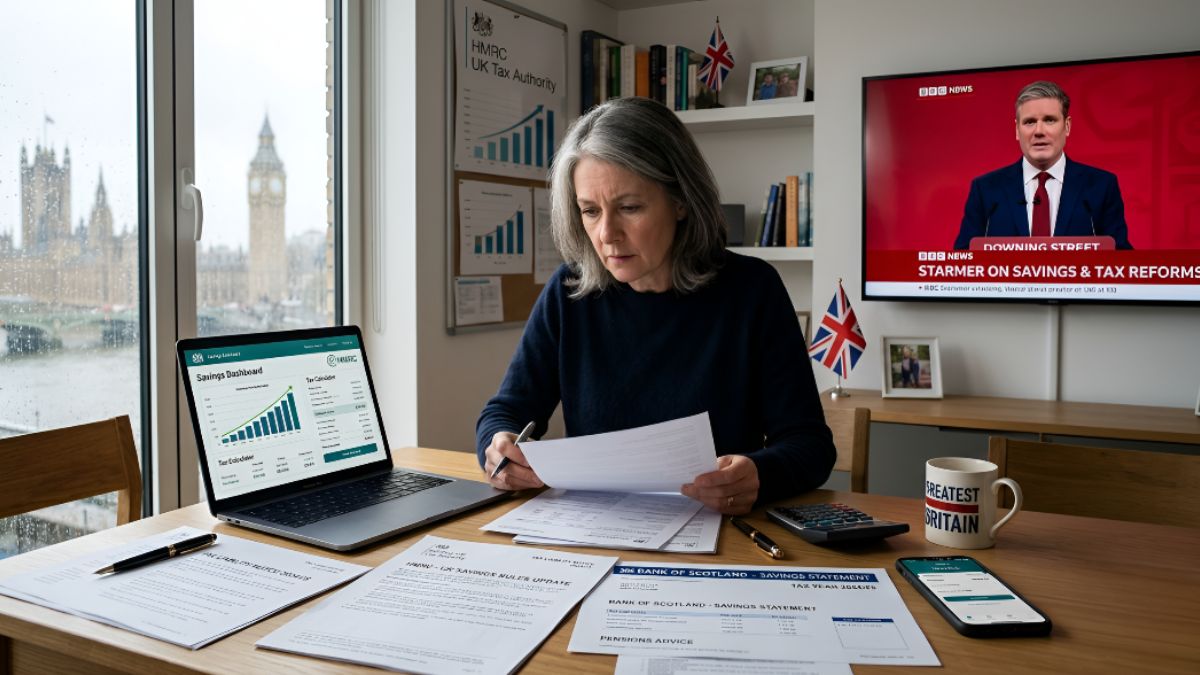

Savers in the United Kingdom could face a major financial shift in the coming years—particularly those under the age of 65. The new savings rules proposed by the government could not only alter their savings strategies but also significantly increase their tax liabilities.
At a time when inflation is constantly on the rise and people are focusing more than ever on saving to secure their future, this change has become a cause for concern among ordinary citizens. Experts believe that this is not merely a minor regulatory tweak but a measure poised to have a profound, long-term impact on people’s financial well-being.
What are the new savings rules, and what is their objective?
The government’s primary objective is to encourage people to shift away from traditional cash savings and move towards investments. To this end, a proposal has been put forward to reduce the annual limit for Cash ISAs (Individual Savings Accounts).
Until now, individuals could deposit up to £20,000 annually into a cash ISA, with all interest earned on that amount remaining completely tax-free. However, plans are now in place to lower this limit to £12,000 starting in April 2027.
This means that those who wish to continue saving at their previous levels will now be required to hold their excess funds in other types of accounts—accounts where the interest earned will be subject to taxation.
It is precisely this change that is expected to become the primary driver behind rising tax bills in the future.

Expert Opinion: Why a “Triple Whammy”?
According to financial expert Laura Suter, this change does not occur in isolation; rather, it is accompanied by two other significant factors that, when combined, could prove to be a “triple whammy” for savers.
- First: A reduction in the Cash ISA allowance.
- Second: A freeze on the Personal Savings Allowance (PSA).
- Third: An increase in tax rates applicable to savings interest.
The cumulative effect of these three factors will result in a tax burden on people’s savings that is far heavier than ever before. Although the government claims that this will encourage people to move towards investment, in reality, most people opt for traditional savings accounts to avoid risk.
The Real Impact of the Cash ISA Reduction
The Cash ISA has long been regarded as a robust option for secure and tax-free savings.
However, once its annual limit is reduced from £20,000 to £12,000, an amount of £8,000 will fall outside the tax-free bracket each year.
If this surplus money is held in a standard savings account, the interest earned on it will be subject to mandatory taxation.
It is precisely these seemingly small sums that, over time, transform into a significant tax liability.
How Does the Personal Savings Allowance (PSA) Work?
Under the UK’s tax system, distinct tax-free limits have been established for individuals across different income brackets:
- Basic Rate Taxpayers: Up to £1,000 in interest is tax-free.
- Higher Rate Taxpayers: Up to £500 is tax-free.
- Additional Rate Taxpayers: No tax-free limit applies.
The issue is that this allowance has not been increased, even as inflation and interest rates continue to rise. This implies that individuals will quickly exceed this threshold and begin incurring tax liabilities.
How Does a Small Sum Lead to a Large Tax Bill?

To take an example: at an interest rate of 4% on a sum of £8,000, the annual income generated amounts to £320.
At first glance, this appears to be a very modest sum; however, as it accumulates over several years, its financial impact becomes substantial.
- Over 5 years: Additional rate taxpayers could face a tax liability of approximately £2,380.
- Over 10 years: This figure could escalate to as much as £9,349.
These figures clearly demonstrate the extent to which the tax burden can grow over time.
Public Mindset and Behaviour
According to research by AJ Bell, approximately 51% of people will not turn to investing, even after the Cash ISA allowance has been reduced.
They will continue to keep their surplus savings in standard bank accounts because:
- They do not wish to take risks.
- They possess limited knowledge regarding investing.
- They prioritise stability and security.
However, this very decision could compel them to pay higher taxes in the future.
Is This Beneficial for the Government?
This change could emerge as a significant source of revenue for the government.
As people begin paying taxes on their savings, the government’s income will rise. Although the budget did not provide a clear figure regarding the total revenue expected from this change, experts believe it constitutes a “hidden tax increase”.
This will allow the government to generate additional revenue without directly raising tax rates.

Potential Options for Savers
In this scenario, individuals have several options available to help them minimise their tax liability:
- Investing in investment funds or the stock market
- Utilising a Stocks & Shares ISA
- Opting for tax-efficient savings plans
- Engaging in long-term financial planning
While investing inherently involves risk, adopting the right strategy and acquiring the necessary knowledge can lead to better returns.
Why Is Future Planning Essential?
This change signals that simply saving money is no longer sufficient; rather, it is crucial to save and invest in a strategic and informed manner.
Individuals should:
- Clearly define their financial goals.
- Understand the applicable tax regulations
- Seek advice from financial experts.
- And periodically review and update their financial plans.
By doing so, they can not only save on taxes but also secure their financial future.
Conclusion
The new savings regulations coming into effect in the United Kingdom could prove to be a major financial shift for individuals under the age of 65.
The reduction in the Cash ISA allowance, the freezing of the Personal Savings Allowance, and changes in tax rates—taken together—could have a profound impact on people’s savings.
Now is the time for every saver to re-evaluate their financial strategy. One can safeguard oneself in this changing financial landscape only by possessing accurate information, exercising prudence, and making timely decisions.
FAQs
Q. What is the new savings rule for under-65s?
A. It involves a reduction in the Cash ISA allowance and changes affecting savings tax.
Q. When will the changes take effect?
A. The new rules are expected to apply from April 2027.
Q. Why could tax bills increase?
A. More savings may be held in taxable accounts, leading to higher tax on interest.
Q. What is the Personal Savings Allowance?
A. It is the amount of interest you can earn tax-free each year, depending on your tax band.
Q. How can savers reduce their tax burden?
A. By using tax-efficient options like ISAs or considering investment strategies.