

There is considerable discussion surrounding the DWP’s (Department for Work and Pensions) monitoring of bank accounts in 2026. The government’s primary objective is to ensure that individuals receiving government benefits are utilizing them in strict accordance with the established rules. The aim of this measure is to prevent fraud and ensure that assistance reaches the intended recipients. However, this subject has also raised numerous questions and concerns among the general public—particularly regarding privacy and the security of personal data.
What Is DWP Bank Account Check?
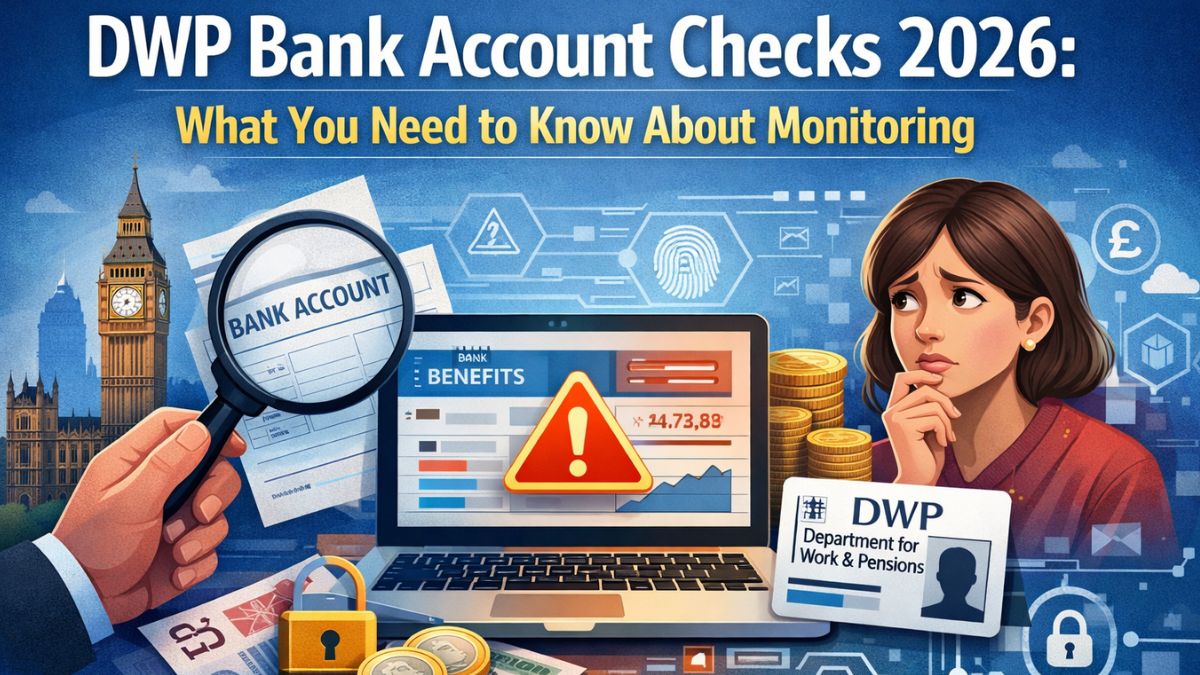
DWP Bank Account Check is a scheme that helps monitor the financial activity of those claiming various government benefits. The main aim of this practice is to check whether there are any cases in which people have incomes and savings above the level defined by the government. When there are cases of funds being held in a bank account above the declared amount, there is likely to be an investigation conducted, which will lead to the suspension of benefit payments.
This procedure can be carried out completely using automation techniques.This does not imply that every minor activity of every individual will be scrutinized; rather, attention will be focused specifically on suspicious cases.

Why is this rule being implemented?
The government states that a significant amount of benefit payments are made erroneously every year.Many people get more benefit through hiding their income. Therefore, the move made by the DWP is an important step that can help in protecting taxpayers’ money as well as making the process more transparent.
In addition to this, this move will also prove to be very useful for the honest claimants as it will lead to minimizing fraud.
Whose life will be changed by this?
This scrutiny will primarily apply to individuals receiving Universal Credit, Pension Credit, or other government benefits. If an individual accurately declares their income and savings, they have no cause for concern.
However, individuals whose accounts receive sudden large deposits—or whose financial activities appear suspicious—may be subject to additional scrutiny. Privacy and Security Concerns the primary concern surrounding this scheme is that of privacy. People want to know whether the government will be monitoring their every transaction. The government asserts that only essential and limited information will be accessed, and that all data protection regulations will be strictly adhered to.
Nevertheless, experts believe that a robust data protection framework is absolutely essential for such surveillance to take place, in order to prevent any potential misuse.

What Precautions Should You Take?
If you are receiving any form of government benefit, you should always keep your financial information up-to-date and accurate. Maintain complete transparency regarding your income, savings, and other financial sources.
In case there are large amounts of deposits in your bank account like a gift, inheritance, or anything else, you must be obliged to notify the authorities. If you fail to do so, it will definitely cause problems later on.
Conclusion
DWP Bank Account Check 2026 is one of the ways through which transparency and fairness is achieved in the system. However, this method cannot be ignored because of its shortcomings that might arise due to privacy.
In case you adhere to the rules and keep your information up to date, then there should be no problem. This is because it is meant for people who misuse the system. In order to protect yourself under this new rule, keep your information updated.
FAQS
Q1. What are DWP bank account checks in 2026?
A. DWP checks are used to monitor claimants’ finances to ensure they meet benefit eligibility rules.
Q2. Will DWP check every bank account?
A. No, checks are mainly focused on suspicious or high-risk cases, not every individual.
Q3. Why is DWP introducing these checks?
A. To prevent fraud, reduce incorrect payments, and ensure fair distribution of benefits.
Q4. Can DWP access my financial data?
A. Yes, but only limited and relevant data is accessed under strict data protection laws.
Q5. What should I do to avoid issues?
A. Always provide accurate financial details and report any changes in income or savings.