

There are moments that are not merely isolated events—they become symbols of an era. The launch of Artemis II from the Kennedy Space Center was one such moment. As the colossal flames of the SLS (Space Launch System) rocket began to illuminate the launch pad and the earth began to tremble, the eyes of the thousands of spectators gathered there welled up with emotion. This was not merely the flight of a rocket; it was the flight of humanity’s indomitable curiosity—a curiosity that has always yearned to transcend the skies and reach unknown worlds. After more than fifty years, humans have once again set course for the Moon—and this time, the journey is not merely a return but a new beginning.
Artemis II is the ambitious mission within NASA’s Artemis program that will carry four astronauts on a loop around the Moon. It marks the first time since Apollo 17 that humans will venture beyond low Earth orbit. The mission also includes Canadian astronauts, making it a truly international achievement. But perhaps the most captivating part of this entire saga is the imagery captured during the launch—photographs that transcend words, speaking directly to the heart.
Kennedy Space Center—Another Golden Moment on Historic Ground
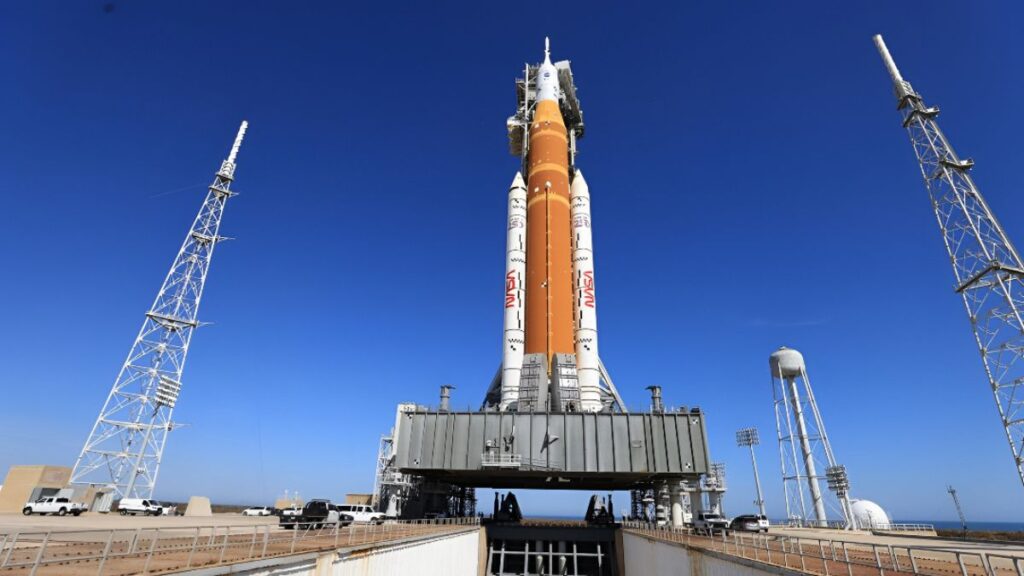
Located at Cape Canaveral, Florida, the Kennedy Space Center is the hallowed ground from which America has launched its grandest space dreams. It was from here that Apollo 11 lifted off in 1969, paving the way for Neil Armstrong to take humanity’s first steps on the Moon. It was from here that the space shuttle program propelled the frontiers of space science forward for decades. And now, this very ground has once again borne witness to history as Artemis II embarked on its momentous journey from this site.
On the eve of the launch, the atmosphere surrounding the Kennedy Space Center was nothing short of festive. Thousands of people had traveled from far and wide to be there—families, children, scientists, journalists, and dreamers—all eager to witness this historic moment with their own eyes. Cameras and binoculars were at the ready. Children held American and Canadian flags in their hands. There was a palpable excitement in the air—the kind of excitement one feels when knowing they are about to become a part of history.
Standing tall on Launch Pad 39B, the SLS rocket glowed like a beacon in the darkness of the night. Towering over 98 meters high, it is the most powerful rocket NASA has ever built. Perched atop it was the Orion capsule, where four astronauts awaited their destiny. Photographers captured images that night that resemble paintings—the brilliant white glow of the rocket against the deep blue of the night sky, reflected in the water below.

That Unforgettable Moment of Launch—Fire, Smoke, and History
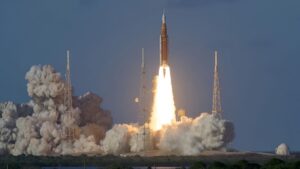
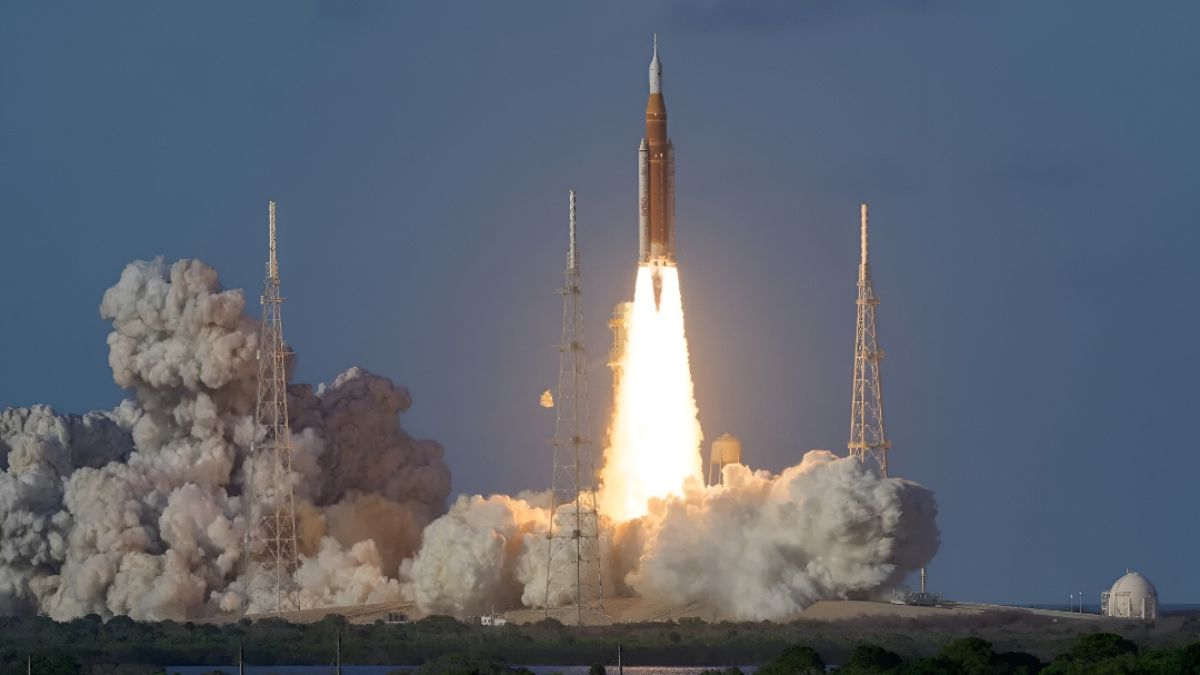
When the countdown reached zero and the SLS engines ignited, the spectacle that unfolded was almost impossible to capture in words. Yet, photographs accomplished what words could not. The images from the first few seconds of the launch are breathtaking—massive orange and white flames engulfed the launch pad, and colossal clouds of steam rose up, shrouding the entire area in a mysterious mist.
As the rocket began to ascend from the Earth, cameras captured moments that will serve as inspiration for generations to come. In one photograph, the rocket hovers just meters above the launch pad, with a colossal column of fire and smoke billowing beneath it—an image that stands as a symbol of power and resolve. In another, the rocket soars upward, piercing through the clouds, leaving behind a luminous trail that traces a golden line across the sky.
Some of the photographs, taken in the morning sunlight of Florida, appear as if they were painted by an artist in a dream. A white rocket against the backdrop of a blue sky, a plume of orange fire beneath it, and the tiny silhouettes of thousands of people standing on Earth—it is a composition that simultaneously captures both the grandeur and the insignificance of human civilization. How small we are in this vast universe, and yet, through the sheer force of our will, we have forged a path to reach the Moon.
Four Astronauts—A Flight of Four Dreams
The most poignant images of Artemis II are those featuring the four astronauts: Reid Wiseman, Victor Glover, Christina Koch, and Canada’s Jeremy Hansen. These four individuals are not merely astronauts; they are representatives of the millions of people who have gazed at the Moon in the night sky and dared to dream.
Victor Glover serves as the pilot for this mission, making him the first Black American astronaut to journey into lunar orbit. This is a historic achievement that serves as a powerful reminder of the American promise—that space belongs to everyone. Christina Koch will be the first woman to venture beyond Low Earth Orbit on such a journey. Her image—captured as she walks toward the launch pad in her spacesuit—sends a powerful message to girls and women across the globe.
Jeremy Hansen is the first Canadian astronaut to travel into lunar orbit, a milestone that underscores the international character of the Artemis program. These photographs are not merely portraits of four individuals; they are images representing all the nations and communities that see their own participation reflected in the pursuit of space exploration. When these four astronauts appeared before the media prior to the launch, every camera captured the quiet determination and faint smiles etched upon their faces. That smile seemed to say, “We are ready.”
The SLS Rocket—A Marvel of Human Engineering
The most impressive subject in the photographs of Artemis II is the SLS rocket itself. Upon beholding the Space Launch System, it is almost impossible to believe that human beings created it. It is so colossal, so powerful, and so magnificent that every photograph of it appears to be a work of art.
The SLS rocket boasts a thrust capability exceeding 8.8 million pounds—making it even more powerful than the Apollo-era Saturn V. Its four RS-25 engines and two solid rocket boosters combine to generate the immense power required to propel a 26-ton Orion capsule all the way to the Moon. At the moment of launch, when these engines ignited simultaneously, their thunderous roar could be heard from a distance of 50 kilometers.
Photographers also captured close-up images of various sections of the rocket, showcasing the intricate complexity and aesthetic beauty of its engineering. Photographs of the engine nozzles—from which blue and orange flames billow forth—resemble abstract works of art. The image capturing the moment of booster separation—as the rocket ascended into the upper layers of the atmosphere and the two solid boosters detached to begin their descent—was a spectacle so moving that it brought even the engineers to tears.
NASA’s Photographs — A Fusion of Science and Art
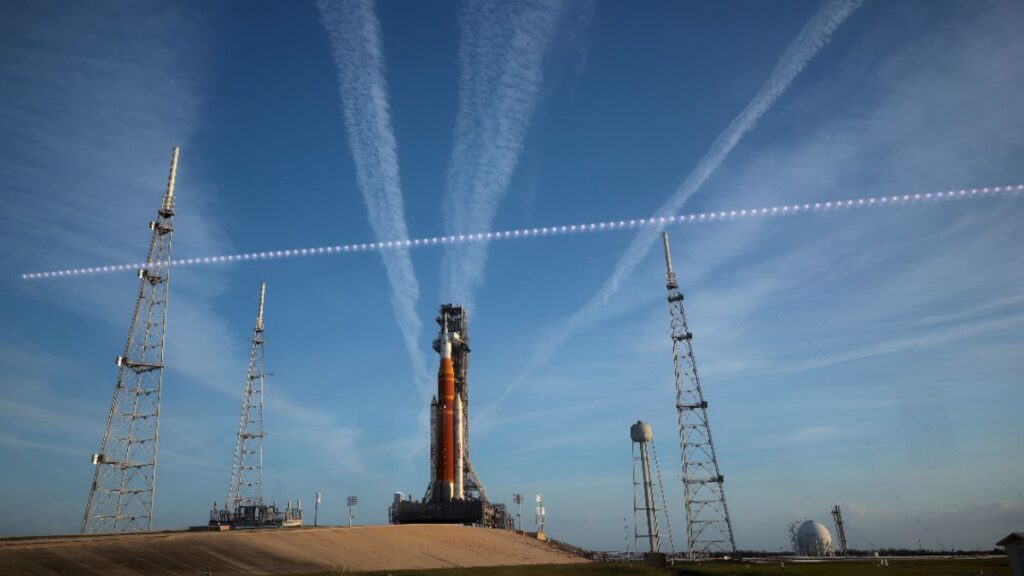
NASA’s photographers spent months preparing to capture the Artemis II launch. Dozens of cameras were strategically positioned at various locations surrounding the launch pad. Some cameras were remotely controlled, enabling them to capture images from the immediate vicinity of the rocket. Others were high-speed cameras capable of capturing thousands of frames per second.
The images yielded by these cameras were truly unprecedented. One particular photograph reveals such intricate detail in the flames erupting from the rocket’s engines that one can clearly discern their structural composition and color gradation—shifting from a blue core to orange outer edges. In the second image, massive fountains of water are visible on the launch pad—this is the sound suppression system designed to protect both the rocket and the pad from the damaging effects of sound waves during launch. This interplay of water and fire created visuals that appear even more spectacular than the special effects in any epic motion picture.
There is a distinct difference between the photographs taken at night and those taken in the morning. The night photographs possess a dramatic aesthetic—the sheer intensity of the light radiating from the rocket’s engines cuts through the darkness, illuminating everything in the vicinity and painting the distant sky with color. The morning photographs, conversely, hold a unique beauty of their own—the long trail of white smoke left in the rocket’s wake against the blue sky looks as if a colossal brush has painted a white stroke across the heavens.
Audience Reactions—A Sea of Emotions
Some of the most memorable images from the Artemis II launch are not those featuring the rocket itself, but rather those capturing the people. Millions of spectators gathered in the viewing areas surrounding the Kennedy Space Center. As the rocket soared into the sky, the expressions that swept across these faces became the most precious elements of any photograph.
One image features an elderly gentleman—perhaps in his early to mid-seventies—with tears welling in his eyes and a smile playing on his lips. He likely belongs to the generation that witnessed the flight of Apollo 11 and is now witnessing Artemis II as well. His face reflects the entire journey of time—fifty years of waiting, culminating finally in a return voyage toward the Moon.
Another photograph depicts a young girl—perhaps seven or eight years old—perched on her father’s shoulders, gazing up at the rocket as it ascends into the sky. Her eyes are wide with wonder, her mouth slightly agape—an expression of pure astonishment unique to the innocence of childhood. This image serves as a symbol of the promise NASA has made regarding the Artemis program—that this very generation will be the one to journey to Mars. For that little girl, this moment today is a seed—the seed of a dream that might, perhaps one day, sprout on the red soil of Mars.

The International Community’s Reaction—The World Watched Together
Artemis II is not merely an American achievement—it is a shared triumph for humanity. This launch was watched live across the globe. In India, Japan, Europe, and Australia—everywhere—people were glued to their screens. Photos and videos went viral rapidly on social media. NASA’s YouTube livestream alone garnered over a million concurrent viewers.
For India, this launch carried a special significance. Scientists at ISRO watched this flight closely, as India, too, is preparing to venture into the realm of human spaceflight with its Gaganyaan mission. The success of Artemis II serves as a message to India’s space scientists: that human spaceflight is indeed possible, and that India is making strides in this very direction.
In Canada, the excitement was even more palpable due to the participation of Jeremy Hansen. The Canadian media hailed it as a moment of national pride. The Canadian prime minister also extended his congratulations on this achievement, declaring it a new beginning for Canada’s space program.
The Scientific Significance of Artemis II — Laying the Foundation for the Future
Beneath these spectacular images and emotional moments lies a profound scientific objective. Artemis II is a test flight; its primary goal is to validate the capabilities of the Orion capsule—specifically those essential for ensuring the safety of human life in space. Data gathered from this mission will inform the planning of Artemis III, the mission in which astronauts will actually set foot on the lunar surface.
Journeying into lunar orbit holds yet another scientific significance: the data and experience gained there will lay the groundwork for future missions to Mars. Mars lies, on average, 220 million kilometers away from Earth, and a journey there takes months. Flying around the Moon serves as the initial preparatory step for that epic voyage. The experience and knowledge that the Artemis II astronauts bring back will prove invaluable in formulating the strategies for a Mars mission.
The Lunar Gateway—a space station to be constructed in lunar orbit—represents the next step in this ambitious endeavor. This station will function much like the International Space Station, though not in Earth’s orbit, but in the Moon’s. Artemis II marks the inaugural flight of this grand vision.
Conclusion: A Picture That Speaks a Thousand Words
Every photograph of the Artemis II launch tells a story—a story of human curiosity, of scientific resolve, and of that indomitable will that propels us toward the unknown. These images are not merely a visual record of a rocket’s flight; they stand as proof that when humanity sets its mind to a task, it can make even the impossible possible.
The grounds of the Kennedy Space Center—from where Apollo took flight decades ago—once again bore witness to history. And the sparkle in that young girl’s eyes was not merely a reflection of the rocket’s fiery exhaust; it was the light of the future. Artemis II did more than simply astound the world—it gave an entire generation a renewed reason to dream. And that, ultimately, is the greatest achievement of any space mission.—Laying
FAQs
Q. What is Artemis II and how is it different from Apollo missions?
A. Artemis II is NASA’s first crewed mission to fly around the Moon since Apollo 17 in 1972. Unlike Apollo, it includes an international crew with a Canadian astronaut, making it a truly global achievement rather than an exclusively American one.
Q. Who are the four astronauts and why are they historically significant?
A. The crew includes Reid Wiseman, Victor Glover, Christina Koch, and Canada’s Jeremy Hansen. Glover is the first Black astronaut to reach lunar orbit, Koch is the first woman to travel beyond low Earth orbit, and Hansen is the first Canadian to journey to the Moon’s vicinity.
Q. How powerful is the SLS rocket that launched Artemis II?
A. The Space Launch System is NASA’s most powerful rocket ever built, generating over 8.8 million pounds of thrust — surpassing even the legendary Apollo-era Saturn V rocket. It stands over 98 meters tall and uses four RS-25 engines combined with two solid rocket boosters.
Q. What is the actual scientific goal of this mission?
A. Artemis II is a test flight to verify that the Orion capsule can safely support humans in deep space. The data collected will directly shape Artemis III, where astronauts will actually land on the Moon for the first time since 1972.
Q. Why does this launch matter for the rest of the world?
A. It signals that human deep space travel is once again a reality, inspiring space agencies worldwide including India’s ISRO. It also reignites public passion for science and gives younger generations a front-row seat to humanity’s next giant leap toward the Moon and eventually Mars.